

Award Honors Australian-German Collaboration for Smoke-Free Homes
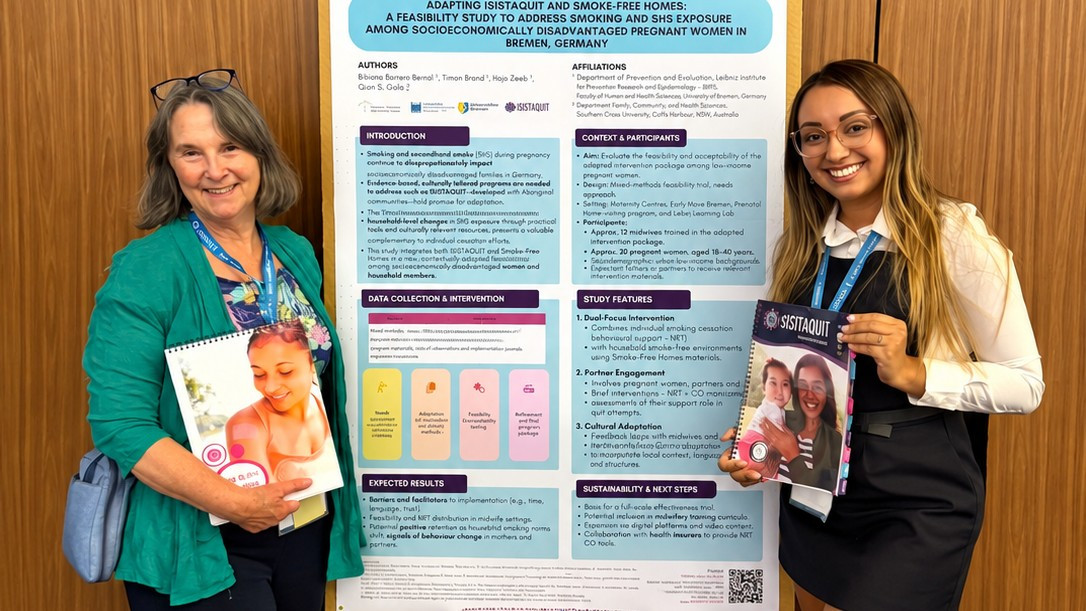
Prof. Gillian Gould (links) und Bibiana Barrera auf der Jahrestagung der Society for Research on Nicotine & Tobacco (SRNT) mit ihrem Poster und den Materialien zur Intervention. (c) Peter van Mourik
Many women who previously smoked quit when they find out they are pregnant. However, partners also play an important role, as their smoking habits can expose pregnant women and newborns to secondhand smoke. In addition, the partner’s behavior affects the mothers’ risk of relapse at the end of the breastfeeding period and, consequently, the children’s chances of growing up smoke-free.
The Australian-German SISTAQUIT collaboration has now received the 2026 SIRC Mission Award from the Society for Implementation Research Collaboration. The award was announced on September 26 at the 2026 SIRC Conference in Minneapolis. The prize recognizes teams that combine implementation research and practical application through trusting partnerships and approaches tailored to the needs of communities.
Australian Intervention Adapted for Bremen
Together with Prof. Gillian Gould’s team at Southern Cross University in Australia, the Leibniz Institute for Prevention Research and Epidemiology (BIPS) adapted SISTAQUIT for Germany. The intervention, designed to support smoking cessation during pregnancy, was originally developed in collaboration with Aboriginal and Torres Strait Islander communities in Australia. According to the project team, the adaptation for Germany marked the first international implementation of the intervention.
In Bremen, the team tested the program through the Pro Kind home-visiting program and at two midwifery centers. The study team found encouraging results from the feasibility study. One participant reported: “My partner no longer smokes cigarettes. Since I joined the project, he’s been using nicotine-free e-cigarettes. He’s confident that he’ll soon be able to quit smoking altogether.”
“We were very impressed by the work and materials from the SISTAQUIT team. Such international collaboration is incredibly important for bringing the best prevention approaches into our healthcare system”, says PD Dr. Tilman Brand, head of the Social Epidemiology Research Group at BIPS.
“This collaboration demonstrates the contribution that international partnerships can make to implementation research. They make it possible to bring together experiences from different countries and to examine under what conditions an approach can also be applied in a different healthcare system and living environment”, adds Bibiana Barrera, a research associate at BIPS. The goal is not simply to transfer a program unchanged. “Rather, what matters most is determining which components might prove effective, what needs to be adapted to local care structures, social conditions, and people’s daily lives, and how to involve those who will later use or implement the program”, says Barrera.
Such an exchange opens up the opportunity for mutual learning: An approach developed in one country can raise new questions in another and be further developed there. “The adaptation must then be tested in the new environment. Only then can it be assessed whether the program is feasible and compatible with local conditions”, explains Brand. In this way, international cooperation can help make research findings usable across national borders without overlooking the differences between the respective contexts.
For SISTAQUIT, this meant adapting an intervention—originally developed in collaboration with Aboriginal and Torres Strait Islander communities in Australia—to the conditions in Bremen and testing it there with partners from the field. This effort has now received international recognition.